Understanding Geometric Decorative Coloring Pattern for Professional and Creative Projects
In the landscape of digital design and creative expression, finding a resource that balances aesthetic complexity with practical usability is often the primary challenge. The Geometric Decorative Coloring Pattern represents a specific category of visual assets designed to meet these rigorous demands. Unlike standard illustrations or organic designs, this style relies on structured symmetry, precise lines, and repeating motifs to create visually engaging compositions. For professionals and hobbyists alike, understanding the nuances of this format is essential before committing to a specific project workflow.
This approach to design is particularly relevant for those seeking high-quality seamless pattern files. The distinct nature of geometric patterns allows them to be scaled without losing integrity, making them ideal for applications ranging from adult coloring books to print-on-demand (POD) merchandise. When evaluating resources, it is crucial to distinguish between simple vector shapes and complex, decorative arrangements that offer depth and texture. The value lies not just in the image itself, but in the versatility of the file structure and the sharpness of the line work.
Distinguishing Features of High-Quality Geometric Patterns
The core distinction of an effective Geometric Decorative Coloring Pattern lies in its technical execution and artistic intent. A common pitfall in this market is encountering images that are either too simplistic or too noisy upon scaling. True high-quality assets maintain clarity at various resolutions. In a professional context, this means that the line work must remain crisp even when printed on large formats or used as backgrounds for text-heavy designs.
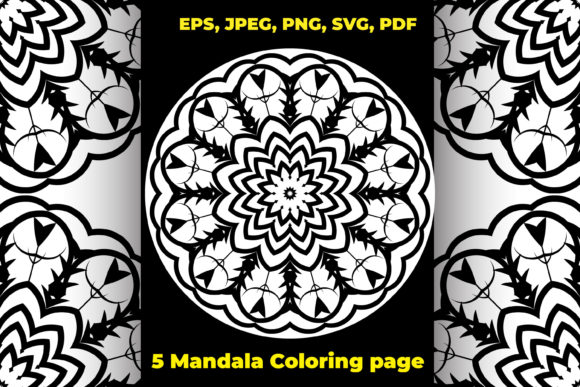
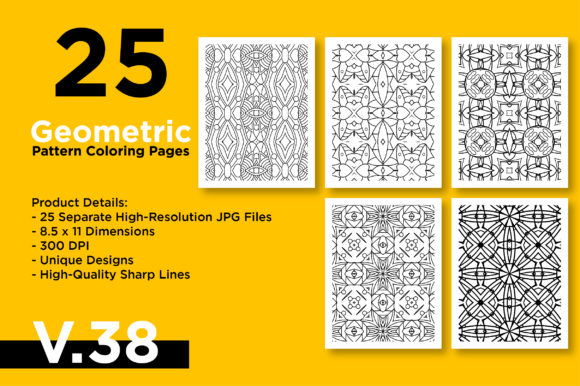
Consider the specifications typically found in premium bundles. Files that measure 8.5 x 11 inches at 300 DPI are considered the industry standard for print-ready materials. This resolution ensures that when a user prints the page for a physical coloring book or transfers the design onto a mug via POD services, the result is free from pixelation or blurring. Furthermore, the presence of unique designs within a collection prevents the "cookie-cutter" feel that plagues many low-cost stock resources. Each pattern should offer a distinct rhythm, whether through interlocking circles, tessellated triangles, or intricate mandala-like structures.
Another critical differentiator is the quality of the lines themselves. In coloring applications, users rely on the boundaries provided by the artwork to guide their creativity. If the lines are jagged, inconsistent, or too faint, the coloring experience is diminished. Sharp, uniform lines provide a satisfying canvas for both traditional media like colored pencils and digital tools. This level of precision is what separates a casual doodle from a professional-grade asset suitable for commercial distribution.
Evaluating Use Cases: From Publishing to Merchandise
One of the most significant advantages of utilizing a dedicated bundle of Geometric Decorative Coloring Pattern files is the breadth of potential applications. These assets are rarely limited to a single output; rather, they serve as foundational elements for diverse projects. Understanding where these patterns fit best helps creators maximize their return on investment.
- Adult Coloring Books: The publishing industry has seen a surge in demand for stress-relief and mindfulness activities. Geometric patterns are particularly effective here because they allow for repetitive, meditative coloring without requiring advanced artistic skills from the end-user. A collection of 25 separate high-resolution JPG files provides enough variety to fill a standard 40-to-60-page book while maintaining thematic consistency.
- Print-on-Demand Products: Entrepreneurs using platforms like Redbubble, Etsy, or Amazon Merch often struggle to find original artwork that fits specific product dimensions. Seamless patterns are invaluable here. They can be tiled across t-shirts, tote bags, and phone cases without visible seams. The ability to download ready-to-use, high-DPI files eliminates the need for time-consuming vector tracing or background removal.
- Book Cover Design: While a full illustration might be necessary for some covers, geometric patterns serve as excellent backdrops or central focal points. Their abstract nature allows them to convey modernity, sophistication, or order, depending on the color palette applied during post-production.
When comparing these use cases, it becomes clear that the file format plays a pivotal role. While vector files (.AI, .EPS) are often preferred for scalability, high-resolution raster files (.JPG) at 300 DPI offer immediate usability for print workflows that do not require further editing of individual strokes. This accessibility makes the Geometric Decorative Coloring Pattern accessible to a wider range of designers who may not have extensive vector software expertise.
Comparing Formats and Alternatives in the Market
When researching options for creative projects, buyers often encounter several alternatives to pre-made geometric bundles. These include hand-drawn organic patterns, purely abstract textures, and generic clip art. Each option presents a different set of tradeoffs regarding effort, cost, and final output quality.
Hand-Drawn Organic Patterns vs. Structured Geometry
Organic patterns, characterized by flowing lines and irregular shapes, offer a more natural, whimsical feel. However, they can be challenging to align perfectly for seamless tiling. In contrast, the structured nature of a Geometric Decorative Coloring Pattern ensures mathematical precision. This makes geometry the superior choice for products requiring exact alignment, such as wrapping paper or fabric design. The tradeoff is that organic styles may feel more "handcrafted," whereas geometric styles lean towards a modern, engineered aesthetic.
Stock Photography vs. Dedicated Coloring Assets
Some creators attempt to adapt stock photography or generic illustrations for coloring purposes. This often results in frustration due to anti-aliasing issues, background noise, or lines that are too thin to hold ink. Dedicated coloring assets are specifically optimized for this purpose. They feature clean black lines on white backgrounds (or transparent), ensuring that the focus remains entirely on the coloring process. The decision factor here is efficiency: purchasing a specialized bundle saves hours of manual cleanup and restoration.
Single Images vs. Bundles
Purchasing a single pattern file might seem cost-effective initially, but it limits the scope of the project. A comprehensive bundle, such as one containing 25 separate files, offers a cohesive library that supports larger productions. For instance, creating a coloring book requires a minimum of 20 to 30 unique pages to justify the printing cost. Buying individually would likely result in higher cumulative costs and a disjointed visual style. The bundled approach ensures that all 25 designs share a consistent line weight, style, and complexity level.
Decision Factors and Potential Limitations
While the benefits of using a high-quality geometric pattern bundle are substantial, it is important to acknowledge scenarios where this specific resource might not be the optimal choice. No single asset type fits every creative need.
Limitations of Raster Formats
Even with 300 DPI resolution, JPG files are raster-based. This means they cannot be infinitely scaled up without eventually losing quality. If a designer plans to enlarge a pattern to billboard size, a vector format would be strictly necessary. Additionally, if the project requires isolating specific elements within the pattern for manipulation, a raster file makes this significantly harder compared to a layered vector file. However, for standard print sizes (up to 11x17 inches) and web usage, the 300 DPI JPGs provided in these bundles are entirely sufficient.
Stylistic Constraints
The rigid structure of geometric patterns may not suit projects aiming for a soft, romantic, or highly illustrative look. If a brand identity relies on fluid, organic curves or detailed character scenes, a strict geometric approach might clash with the desired mood. In such cases, exploring mixed-media collections or floral/organic bundles would be a more appropriate alternative. The key is to match the visual language of the pattern to the emotional tone of the final product.
Commercial Licensing Considerations
For those entering the POD market, understanding the licensing terms is vital. While many bundles allow for commercial use, restrictions may exist regarding the number of copies sold or the types of products allowed. It is always prudent to verify the license agreement before launching a product line. Assuming a pattern is free for unlimited commercial use without checking the fine print can lead to legal complications later.
Maximizing Value Through Strategic Selection
To make the most informed decision, creators should evaluate their specific project requirements against the attributes of the available resources. If the goal is to produce a high-volume coloring book or a series of merchandise items quickly, a bundle of Geometric Decorative Coloring Pattern files offers an efficient solution. The combination of high resolution, unique designs, and sharp lines reduces the need for post-processing, allowing the creator to focus on marketing and sales.
Conversely, if the project involves custom branding or requires infinite scalability for large-scale installations, investing time in hiring a designer to create custom vector graphics might yield better long-term results. The choice ultimately depends on the balance between budget, timeline, and the desired aesthetic outcome.
By carefully considering factors such as resolution, line quality, and versatility, professionals can determine if a geometric pattern bundle aligns with their strategic goals. Whether for personal relaxation or commercial enterprise, the right pattern serves as the foundation for a successful creative endeavor. The availability of 25 distinct, high-quality options ensures that there is ample material to explore various themes and styles without compromising on the integrity of the design.